
Reversed knowledge hierarchy - PART II
The shift from content to process as a strategic advantage

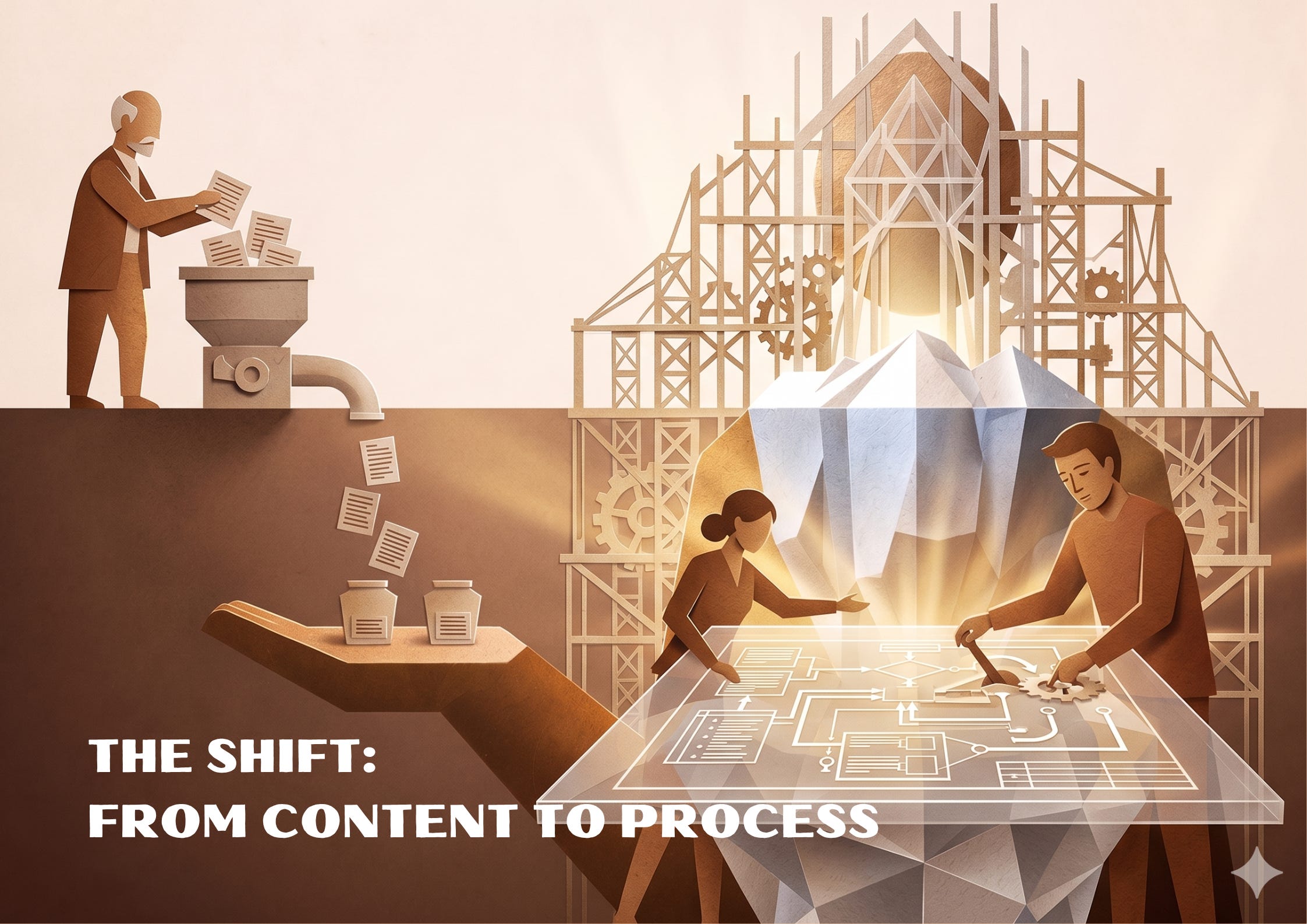
The shift, mentioned in part I, has consequences that go far beyond classroom dynamics: it redefines how we think about scalability, expertise and return on investment in ESP and Business English training.
The shift from content to process: The strategic advantage
The shift toward framework-based instruction is not merely a pedagogical preference; it is a strategic response to the increasing hyper-specialisation of the global workforce. In environments where one team works on mergers, another on ESG reporting, and yet another on embedded systems for IoT, the fantasy that a single trainer can be an “industry expert” in every niche has quietly collapsed. This reinforces what we established earlier.
When we pivot from being content providers to process architects, we solve the scalability problem that has long plagued high-end ESP (English for Specific Purposes) training. Instead of frantically updating slide decks with the latest jargon, we invest in reusable frameworks, discourse patterns, and decision-making tools that can be populated with the learner’s own domain knowledge. The methodology becomes portable, while the content becomes hyper-local and live.
To understand the gravity of this shift, look no further than the world of software development. As recent work with an IT engineering team shows, this shift is not theoretical; it’s already reshaping how expertise is perceived in the classroom nowadays.
Expertise has been redefined
We are witnessing a brutal devaluation of 'encyclopedic knowledge.' Take programming as a prime example: not long ago, a Senior Developer’s value was measured by their rote mastery of syntax and complex libraries. Today, equipped with tools like Cursor or GitHub Copilot, or any AI programming tool, a Junior can generate functional code in mere seconds. The core of expertise has fundamentally shifted from the technical hurdle of 'how to write it' to the strategic vision of 'what is worth building'—and the intuition of how to debug it when it breaks. In this new landscape, raw technical knowledge has been commodified, while critical thinking has become the ultimate luxury. Let’s have a look at the business. The shift is undeniable: raw linguistic data has been commoditized. If the value of a course were measured by the volume of content, every language textbook on a shelf would be a goldmine. But it isn't. The true premium has shifted from the 'what' to the 'how'—moving the trainer away from being a content-provider and toward the role of a ‘performance architect’ who builds systems for real-world impact.
From syllabus to system
Traditional ESP and Business English courses are still largely built around a fixed syllabus: pre-selected topics, curated texts, and a progression of grammar and lexis that assumes a relatively stable professional reality. We all work with coursebooks like Market Leader, Business Partner, or Business Result... and we’re all just fighting for survival. Don’t get me wrong—methodologically speaking, these are excellent courses. But for a C-suite executive, they are often methodologically sound but contextually bankrupt. That model works tolerably well for junior staff or broad, cross-sector skills but quickly breaks down when learners move into senior, cross-functional or highly technical roles.
A process-architect approach inverts this logic.
Instead of asking,
“Which units will we cover this semester?”,
the trainer asks,
“Which recurring communication processes shape your week, your quarter, your career trajectory?”
These might include:
Presenting risk scenarios to the board.
Negotiating SLAs with vendors across jurisdictions.
Writing investigation reports after safety incidents.
Leading cross-border agile ceremonies with mixed-proficiency teams.
Each of these processes can be unpacked into predictable genres (briefing, report, recommendation, escalation), discourse moves (framing, justifying, hedging, signalling risk), and interactional patterns (probing, clarifying, disagreeing diplomatically). The trainer’s value lies in designing robust frameworks for these moves and then “plugging in” the learner’s own content.
The learner’s reality as textbook
When the learner’s professional reality becomes the core textbook, the notion of “relevance” shifts from cosmetic to structural. The email that nearly derailed a deal last week, the risk register that the team struggles to update, the slide deck going to the investment committee tomorrow – these are no longer “extra materials”. They are the curriculum.
Two effects follow immediately:
Automatic scaling of complexity
A mid-level engineer will bring different artefacts than a C-level executive – different stakeholders, stakes, and time horizons. Because the framework is the same (e.g., risk briefing, decision memo, stakeholder alignment meeting), the linguistic and cognitive load adjusts organically to the learner’s reality and seniority.Elimination of the transfer gap
Classic corporate training suffers from “knowledge leakage”: polished roleplays in the classroom, followed by reversion to old habits at work. If the 'practice environment' is the learner’s real work, there is no gap to bridge. We call this Zero-Latency Learning (no gap between practice in class and deployment at work): the learner exits the session and immediately sends the high-stakes email they just refined. This is the ultimate proof of ROI.
The lesson is the job, and the job is the lesson.
The trainer ceases to be the source of content and becomes the architect of a learning ecosystem in which real artefacts circulate, are deconstructed, upgraded, redeployed, and evaluated in terms of concrete business outcomes.
Strategic tools for modern ESP
1. Dynamic scaffolding- stable form, fluid content
Dynamic scaffolds are flexible structures that give shape to complexity without predetermining the content. Think:
SWOT or PESTLE frames for strategic conversations.
Stakeholder maps for alignment and influence planning.
Risk matrices for safety, compliance, or supply chain discussions.
Decision-making canvases for go/no-go, prioritisation, or scenario planning.
These tools are “domain-agnostic”: the same template can be used in pharma, fintech, renewable energy, or higher education. What changes is the data that the learner pours into the structure – their metrics, constraints, and regulatory landscape.
The trainer provides:
The communicative macro-structure (how to frame the issue, sequence arguments, signal trade-offs).
Language resources (functional phrases, rhetorical strategies, register calibration) mapped to each stage of the scaffold.
Real-time coaching on precision, nuance, and persuasive impact as learners populate the scaffold with their own data.
In other words, the trainer owns the form; the learner owns the content. The result is high cognitive load, high relevance, and high transfer – achieved without the trainer pretending to be a mini-consultant in every industry.
2. The Socratic stance
In a hyper-specialised economy, the trainer’s default stance cannot be “explainer-in-chief”. It must be Socratic: structured inquiry that compels the learner to externalise their expertise in the target language.
Instead of explaining terminology, the trainer asks:
“Walk me through the critical path of this project, step by step, as you would to a sceptical stakeholder.”
“What is the worst-case scenario in this risk register, and how would you justify the mitigation strategy?”
“How would you frame this change initiative to frontline staff vs. the board?
More often than not, a learner’s struggle to communicate in English isn't a vocabulary deficit; it’s a failure of structural clarity in their native thought process. The trainer acts as a clarity filter. By forcing the learner to explain complex concepts to an 'informed layman,' we expose logic gaps and structural weaknesses that would otherwise pass unnoticed in their L1. We aren't just teaching them to speak; we are teaching them to think with greater precision.
These questions do several high-value things simultaneously:
Force the learner to organise complex knowledge in English, not just translate isolated items.
Surface the discourse moves and narrative arcs that actually drive decisions in their context.
Reveal real gaps: unclear logic, missing stakeholders, weak justification – which the trainer can then address linguistically and structurally.
The trainer’s “ignorance” of the niche becomes an asset: they can insist on clarity, coherence and audience-friendly framing, without being seduced by content familiarity. This is exactly what most experts lack in their first language, let alone in English.
3. From raw output to boardroom-ready performance
Once the learner’s expert “raw material” is on the table – a messy explanation, a rough draft of an email, a spontaneous monologue about a crisis – the trainer’s job is to refine.
This refinement operates on several layers:
Micro level – accuracy and clarity
Tightening grammar and syntax, resolving ambiguity, eliminating false friends, and polishing collocations.Meso level – register and genre
Shifting from “speaking like a subject-matter geek” to “speaking like a leader”: hedging or de-hedging strategically, managing politeness and directness, aligning tone with corporate culture and industry norms.Macro level – rhetoric and narrative
Strengthening argument flow, contrast, emphasis, and calls to action, using discourse markers, signposting, and storytelling devices that resonate in international boardrooms.
Crucially, this is not a one-off correction pass. High-ROI workplace programs are designed around continuous assessment and iterative tuning of tasks based on real-world outcomes. The loop looks like this:
Prepare: upgrade the language for an upcoming real event (presentation, negotiation, call).
Deploy: learner uses it “in the wild”.
Debrief: what worked, what did not, what responses and questions arose.
Refine: adjust language and strategy; feed learning back into the framework.
Over time, the learner builds a personal repertoire of high-impact language moves directly linked to their role and KPIs.
This framework is a clear professional application of Kolb’s Experiential Learning Cycle, specifically tailored for high-stakes business environments. By shifting from abstract theory to a continuous loop of “Deploy, Debrief, and Refine,” it transforms everyday workplace interactions into intentional opportunities for skill acquisition. It effectively weaponises Kolb’s principles to ensure that learning isn’t just a one-off event, but a strategic driver of measurable ROI.
(to be continued…)