
Reversed knowledge hierarchy - PART III
Impact on ROI and Business Outcomes


Why stakeholders care about process, not just proficiency
In earlier parts of this series, I argued that what looks like “language training” is in fact knowledge work on processes and participation, not just accumulation of linguistic data – a shift that mirrors the move from a linear DIKW pyramid to a reversed knowledge hierarchy in knowledge management. In 2026, corporate language training quietly stopped being about English as such. It became about operational clarity, risk and throughput. For HR, L&D and business unit leaders, language training is no longer a “nice-to-have” perk; it is an investment expected to move hard metrics, not just make people feel more confident.
Providers of workforce English consistently report that ROI becomes compelling only when programs:
Target real job tasks rather than generic topics.
Are co-designed with managers and technical experts.
Include mechanisms for tracking changes in performance metrics (errors, rework, safety incidents, time-to-productivity, customer satisfaction).
When those conditions are in place, documented cases of workplace English programs show returns that go far beyond “employees are happier speaking English”. Companies report:
Fewer misunderstandings and costly mistakes in multilingual teams.
Reduced safety incidents on worksites.
Faster onboarding of international hires.
Higher retention and engagement among staff who feel linguistically empowered.
A process‑architect model is engineered to hit exactly these levers, because training is anchored in real workflows and measured against real indicators from day one.
If your English program still teaches vocabulary lists from the coursebook, it is not future‑proof. It is legacy.
Traditional vs framework-based model
Here is what happens when “content” quietly becomes the enemy of outcomes.
Two underlying value propositions emerge when we compare the traditional, content‑heavy model with a framework‑based, learner‑as‑resource approach:
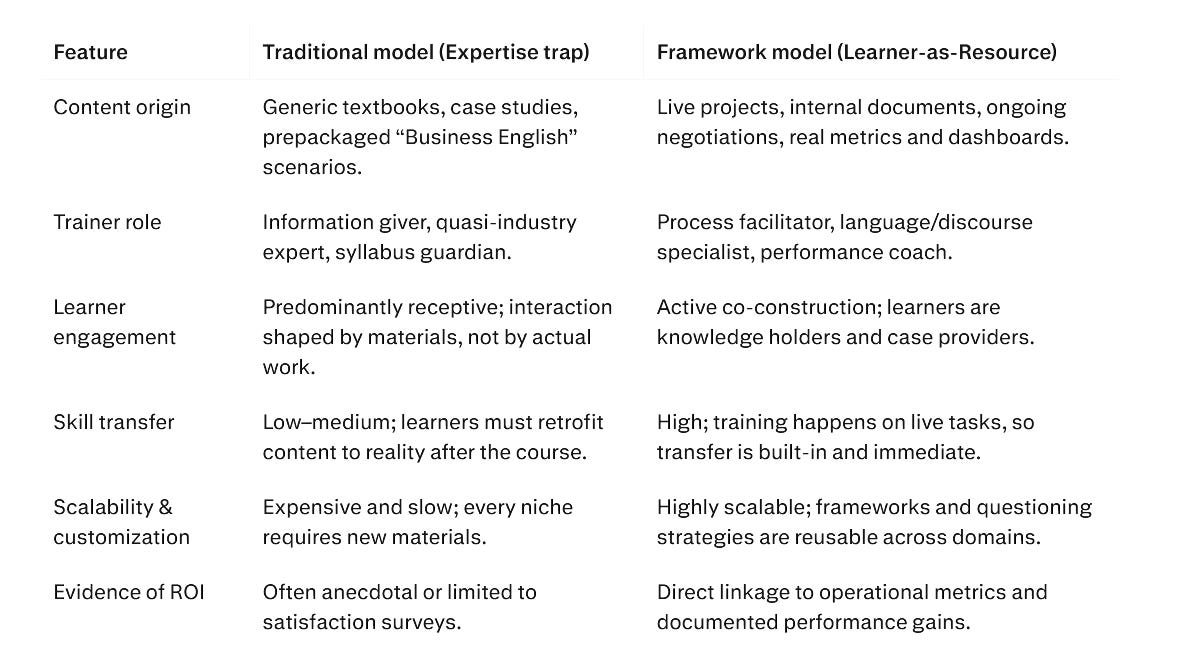
Every L&D leader I speak with faces the same tension: how to prove that language training drives the metrics that matter. When seen through that lens, the second column is far easier to defend in a boardroom.
Reclaiming professional authority in the age of AI
The rise of AI‑driven language tools is shifting the power balance in ELT, especially in ESP and Business English. Apps can already:
Provide on‑demand grammar explanations.
Offer pronunciation feedback and drilling.
Translate emails or slide decks into usable English.
If the trainer’s professional identity is tied to being “the walking grammar book” or “the human vocabulary list”, that role is increasingly under threat. What remains uniquely human – and strategically valuable – is the capacity to:
Read organizational context and politics.
Facilitate difficult conversations safely.
Design tasks that surface real risk, conflict and ambiguity.
Coach professionals through identity shifts (“from engineer to leader”, “from local manager to global stakeholder”).
Letting go of the “industry expert” persona does not diminish the trainer’s value; it amplifies it. It positions the ELT professional as a high‑level consultant who unlocks existing potential in the client’s workforce by orchestrating processes where expertise, language and strategy intersect.
In this configuration:
AI becomes an assistant (for micro‑level support: lookups, practice, transcription).
The learner brings domain mastery and access to real work.
The trainer designs and facilitates the learning architecture in which both can operate effectively.
The message has to be clear: AI does not replace the trainer; it replaces the trainer’s comfort zone.
We are not teaching English anymore
In an era where AI can provide instant translations and generic grammar explanations, the human trainer’s unique value lies in symbiotic facilitation. The work is less about “teaching English” and more about coaching professionals to exercise their existing expertise through the medium of English – under real constraints, in real time, with real consequences.
This is the pulse of modern ELT in the corporate and ESP space:
Agile, because the content stream is live and constantly changing.
Authentic, because tasks are drawn from the learner’s operational reality.
Unapologetically grounded in the learner’s world, not in the comfort zone of the coursebook.
The strategic question for us as ELT professionals is no longer, “Which topics should we cover this semester?” but rather: “Which processes will we help our learners own – in English – so that their organisations cannot imagine operating without them?”