
AI Fatigue
Assessing the impact of AI saturation on student and teacher well-being: A strategic roadmap for 2026.

GLOBAL PULSE | INDUSTRY INSIGHTS
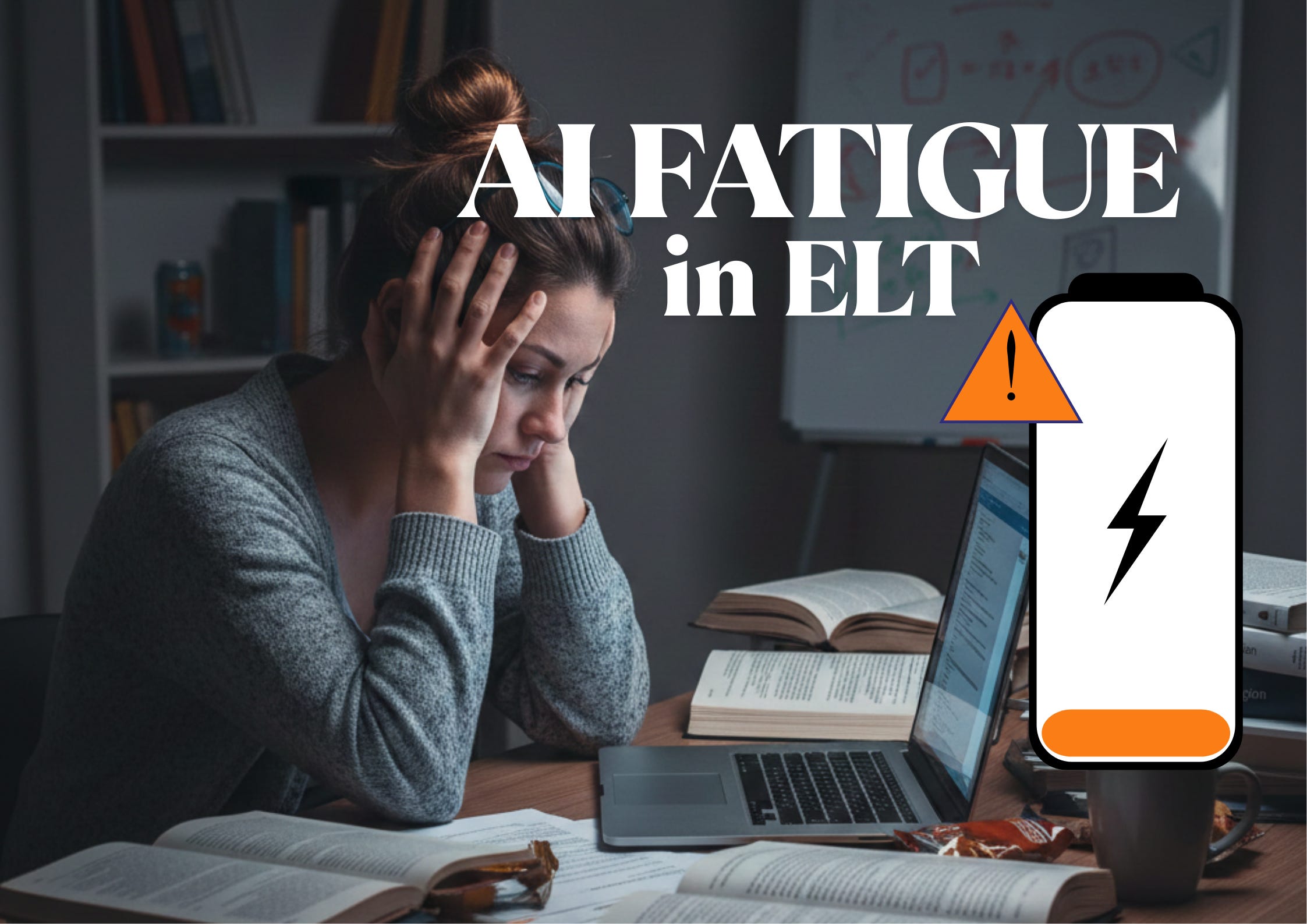
AI Fatigue
We are all tired.
Not the end-of-term tired. Not the after-exam tired.
A different kind.
In recent weeks, I have been talking to language teachers—from those in the state school system to language school tutors and Business English trainers. The conclusion? We all feel the same. We are all exhausted. It is a specific kind of resignation. What I am observing is more than just simple “innovation weariness.” It is classic digital burnout transferred to the field of education—in our case, language education.
It is a state of physical and emotional exhaustion, manifested in a drop in motivation and a feeling that, instead of teaching, we are fighting an algorithm. Although AI promised a revolution and a reduced workload, it has paradoxically introduced a new kind of exhaustion: AI fatigue. Quick dive: How AI fatigue hits teachers—and drains students.
The Teacher
The dream of stability
AI fatigue isn’t really about AI.
It’s about change. Endless change.
Both businesses and language schools operate within a logic of constant transformation, where new reforms and tools appear faster than teachers can meaningfully integrate them into their practice.
Already in the 2024 TALIS reports, teachers spoke openly about growing exhaustion caused by rising demands, combined with a lack of stable working conditions and time for pedagogical reflection. AI changes the “how,” but it does not address the deeper questions related to the “why” of a teacher’s work.
In the business world, change fatigue is described as a state of exhaustion resulting from an overload of initiatives and the pressure of continuous adaptation, which lowers engagement and increases resistance to new projects. Thus, in language education, this dynamic takes the form of AI fatigue: teachers and students are bombarded with promises of “breakthrough” tools—from lesson plan generators to adaptive systems and automated feedback. Yet implementing each new platform requires additional training, redesigning materials, and mastering new interfaces. On top of that, proactive tutors often experiment with dozens of smaller digital tools, creating constant pressure to keep up with the latest version of an idealized, fully automated course.
Talking to a secondary school teacher, she described a pattern that has become routine. Before a unit on reported speech, she generated a full lesson sequence using one of the popular AI tools: lead-in, controlled practice, freer speaking task, and homework. The structure appeared methodologically sound. However, closer inspection revealed inconsistencies. The controlled exercises included forms not yet introduced. The freer task required lexical items beyond the group’s productive range. One example sentence contained a subtle grammatical inaccuracy. She adjusted the materials. Then cross-checked the answer key. Next, she simplified instructions to match her students’ reading level. The preparation process took 70 minutes. Her previous non-AI planning routine for a comparable lesson typically required circa 30.
“The tool is impressive,” she concluded. “But I cannot afford not to verify it.”
At a certain level of professional responsibility, verifying AI-generated content is not optional; it is necessary, time-consuming, and, over time, quietly frustrating.
The problem is not the technology itself, but the accumulation of tools without a coherent strategy—and the growing sense that the heart of the profession, the relationship with the student, is being pushed to the margins. As a result, AI is increasingly perceived not as support but as yet another layer of demands that intensifies exhaustion.
In many countries, leadership anxiety slows down meaningful AI integration.
In Poland, where I work, this often takes the form of an additional barrier. Many school leaders do not fully understand how AI works and therefore perceive it as a threat or an unnecessary expense rather than a strategic investment. Instead of developing thoughtful, forward-looking policies, leadership often responds with knee-jerk bans on smartphones and AI tools. The Ministry of National Education (MEN) plans to implement a complete ban on phones in schools starting September 1, 2026 – schools will be able to enforce it through their statutes, including deposits or confiscation. (Really?!) This creates a challenging environment for forward-thinking educators. School directors are frequently paralysed by concerns over GDPR compliance (Polish RODO) and potential legal risks. Teachers thus find themselves fighting on two fronts—against imperfect algorithms and against bureaucratic resistance within their own institutions. Rather than feeling supported, they feel caught between the potential of new technology and the caution of their supervisors. The outcome is a deeper sense of exhaustion. When innovation is met with resistance instead of curiosity, it is often the most creative teachers who burn out first.
In Polish public schools, a significant technological gap further exacerbates the problem. Many institutions lack the budget for premium AI licenses, leaving teachers and students reliant on basic, free versions. These tools happen to be unreliable—they glitch, generate inaccuracies, or hallucinate, creating more work instead of saving time. A frustrating cycle emerges: instead of teaching, educators spend their energy verifying AI-generated lesson plans and correcting automated exercises. While private schools invest in stable, high-quality solutions, public school teachers are left to “fight the algorithm” daily. When technology is unreliable or poorly implemented, it deepens change fatigue. Teachers feel burned out because they are troubleshooting technical issues rather than building meaningful relationships with their students. Without a clear national strategy and adequate funding for reliable tools, Polish educators risk remaining trapped in a form of digital poverty, where AI feels less like a support system and more like an additional burden.
The Student
The trap of apparent ease
For a methodologist, this is perhaps the most alarming aspect: student fatigue in the AI era results not from excessive study, but paradoxically, from a lack of effort. In other words, students stop exercising the mental muscles they need most.
There’s even a term emerging for this: AI-induced cognitive atrophy. The term AICICA, coined by UNESCO last year (AI Chatbot-Induced Cognitive Atrophy; UNESCO, 2025), suggests that the apparent support provided by AI can weaken core cognitive functions. A student accustomed to receiving instant, polished answers gradually stops training working memory, attention, and logical reasoning.
In a Business English course, my B1-level student submitted a remarkably sophisticated essay on remote work productivity. The structure was coherent, the vocabulary advanced, the argument balanced. During feedback, I asked him to explain one of the key claims in his own words. He hesitated. Then smiled awkwardly.
“I’m not sure,” he admitted. “I just asked ChatGPT to make it sound better.”
The language was accurate. The learning was minimal. What looked like progress was, in fact, delegation.
When AI writes the essay or corrects pronunciation, the student loses a sense of authorship (Loss of Agency). Learning becomes a performance in which the student plays only a supporting role. This leads to diminished intrinsic satisfaction, as authentic intellectual effort is replaced by passive supervision of machine-generated output.
Although chatbots are patient (yep, new AI-powered language courses promising fluency overnight are popping up like mushrooms after the rain), they do not create a shared emotional or social context. They create cognitive loneliness. Language learning is inherently a social process, requiring the negotiation of meaning, moments of misunderstanding, and shared frustration. Replacing these experiences with AI-mediated interaction can make the developmental process sterile, leading to a sense of not belonging to a learning community.
The concept finds strong confirmation in the Polish context. The White Paper on AI in Polish Schools, published by PAN in 2025, explicitly warned that the automation of educational interactions carries the risk of “deepening a sense of loneliness, isolation, and anxiety” among students. The report identified a concerning shift in classroom dynamics: students who passively rely on AI tools—the “copy-paste” approach—are beginning to manufacture an advantage over peers who choose to work independently. This not only erodes work ethic but also fosters a culture of uncritical dependence. As the PAN experts note, there is a significant risk that students will “rely too heavily and uncritically on AI-generated output,” leading to a decline in critical thinking skills and in their ability to verify information independently.
The Solution
The “I–Thou” (I–You) strategy
The solution is not to throw computers out the window, but to adopt a human-centred approach. Here's a quick glance at the three pillars of renewal.
Digital balance: Just as an athlete needs recovery, the brain requires regular “pause windows” from technology. Digital tasks should be intentionally combined with fully analogue activities.
Relational education: Drawing on Martin Buber’s concept, frequently cited by UNESCO, education is grounded in the “I–Thou” encounter between two people. AI can only offer an “I–It” interaction with an object. Use AI as a tool, but invest emotions in people. Machines cannot care, empathise, or struggle alongside a student as a human can.
Critical literacy: Rather than banning AI, we must teach students how it works and where its limitations lie. Excessive reliance on chatbots leads to cognitive offloading, potentially resulting in weaker long-term learning outcomes. We must also remain aware of the risk of cultural homogenization, as AI systems often overlook the local nuances that are essential to meaningful language learning.
True innovation for 2026 is not about replacing humans with better algorithms, but about using technology wisely so that we have more energy for what matters most: relationships, inspiration, and mentorship.
Maybe the real revolution of 2026 isn’t smarter AI.
Maybe it’s the courage to slow down in ELT.
How does this look from your perspective? Do you dream of a “period of stability,” or are you still hungry for innovation? Let me know in the comments.
💓 Pulse Check: Navigating AI Fatigue in your ELT practice
Here are 3 actionable strategic shifts to implement this week:
1. For Language Instructors: The “Human-in-the-Loop” verification
Automation should never come at the cost of authenticity.
Action: Audit your lesson preparation workflow. Select just one specific area (e.g., generating reading comprehension) where AI assists you, but commit to a “final mile” manual edit. Ensure the output reflects your students’ specific cultural context and personal goals—something no LLM can truly replicate.
2. For Language School Owners: The digital load audit
Operational efficiency often masks cognitive burnout among staff.
Action: Conduct a “Tool utility survey.” Ask your team which three digital platforms or minor tools provide the most value and which ones feel like “digital clutter.” Deprioritise or eliminate tools that contribute to friction rather than flow. Simplify the tech stack to amplify human connection.
3. For Directors of Studies & Methodologists: Fostering Cognitive Agency
Moving from passive AI consumption to active critical thinking.
Action: Integrate “Comparative analysis” tasks into your curriculum. Have students generate an essay or argument using AI, then—without digital aids—require them to peer-review, challenge, and manually rewrite sections for better rhetorical impact. Reclaim the classroom as a space for deep, unassisted thought.
If this resonates, share it with a colleague who is quietly burning out over ‘innovative’ tools.